
Flexible Current Probe for Measuring Capacitor Discharge Transient Currents
1. Characteristics of Capacitor Discharge Current
During capacitor discharge, the charge stored in the capacitor is rapidly released through an external circuit, with high-frequency, high-current pulses. The waveform characteristics include:
①Fast rising edge: The current rise time during discharge can reach microsecond levels (e.g., 5 μs), requiring high-bandwidth probes to capture the details.
②High-current peaks: Energy storage capacitors can discharge currents reaching hundreds of amperes, requiring wide-range probes to prevent signal saturation.
③High-frequency oscillation: Loop inductance and capacitance form LC resonance, requiring the probe to possess high signal-to-noise ratio and phase consistency.
Traditional current transformers struggle to meet requirements due to bandwidth limitations and magnetic saturation issues. In contrast, the DK-0700 used in this experiment proves an ideal choice thanks to its non-contact design and high-frequency response characteristics.
2. Advantages of the DK-0700 Probe
①High-frequency bandwidth and transient capture capability.
Bandwidth Coverage: DC-50Hz to 10MHz, meeting capacitive discharge pulse rise time requirements (e.g., a 100ns pulse requires 3.5MHz bandwidth).
Anti-interference Design: 14mV peak-to-peak noise level, combined with the oscilloscope's high-resolution mode, effectively suppresses noise in high-frequency oscillations.
②High-Current Measurement and Safety
Range: 7A to 700A, covering typical capacitor discharge scenarios (e.g., supercapacitor banks or power electronics testing).
Withstand Voltage Protection: Coil rated at 3kV withstand voltage, suitable for high-voltage capacitive circuit measurements to prevent breakdown risks.
③Flexible installation and calibration features
Non-invasive measurement: Flexible coils can be wrapped around conductors for installation, accommodating confined space layouts.
3. Setup and Operation Procedures for the Measurement System
①Experimental Equipment:
DC Stabilized Power Supply PA2002 (200V 2A)
High-Voltage CBB Capacitor (Example Specification: 10μF 275V)
PINTECH DK-0700 Flexible Current Probe (10MHz Bandwidth, Range 700A)
Digital Oscilloscope MDO7500A
Discharge Load: Power Resistor
Insulated Tools: Ceramic Tweezers, Insulated Gloves
②Safety Protection Measures:
High-voltage protection: Wear insulated gloves when operating voltages above 80V; install insulating rubber mats in the experimental area.
Grounding protection: Ensure the power supply, capacitor casing, and oscilloscope share a common ground to eliminate potential difference risks.
③Assemble the circuit:
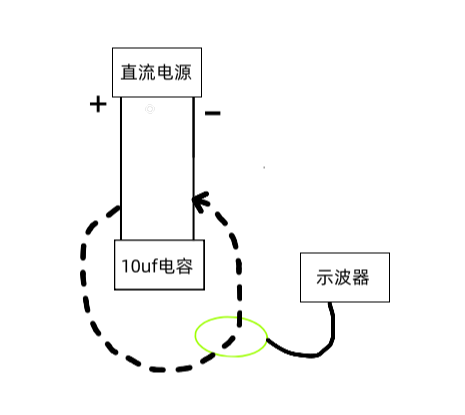
Connect the capacitor to the DC power supply. Attach the probe to the oscilloscope. Select the connection cable and first connect it to the capacitor side (the instantaneous current can reach several hundred amperes; ordinary cables may be instantly charred black by the current). Loop the clip-around coil around the connection cable. Set the relevant parameters on the oscilloscope.
Experimental Procedure:
①Low-Voltage Pre-Test (5V Charging)
Set the power supply output to 5V and initiate charging for 10 seconds (to ensure stable capacitor voltage).
Safe Discharge Procedure: Using insulated tweezers, briefly touch both terminals of the capacitor (for <0.5 seconds) to simulate rapid discharge.
Record the current waveform captured by the oscilloscope, analyze the peak current and rise time (expected values: peak current of approximately 50A at 5V, rise time in the microsecond range).
②High-Voltage Testing (120V Charging)
20V Stage:
Charge to 20V, lightly touch the discharge point with a copper rod, observe the waveform oscillation characteristics, and record the peak current (approximately 50A).
50V stage:
Set the power supply output to 50V and initiate charging for 10 seconds (to ensure stable capacitor voltage). Briefly touch both terminals of the capacitor (for <0.5 seconds), observe the waveform oscillation characteristics, and record the peak current (approximately 100A).
80V Test:
Before charging, verify the capacitor's rated voltage (≥100V). After charging completes, discharge by shorting the capacitor terminals. The DK-0700 captures the transient current (expected peak 100-150A).
100V Test:
After charging is complete, discharge by shorting the capacitor terminals. The DK-0700 captures the transient current (expected peak of 150-200A).
120V Test:
After charging is complete, discharge is achieved by shorting the capacitor terminals. The DK-0700 captures the transient current (expected peak of 200-300A).
4. Data Recording and Analysis
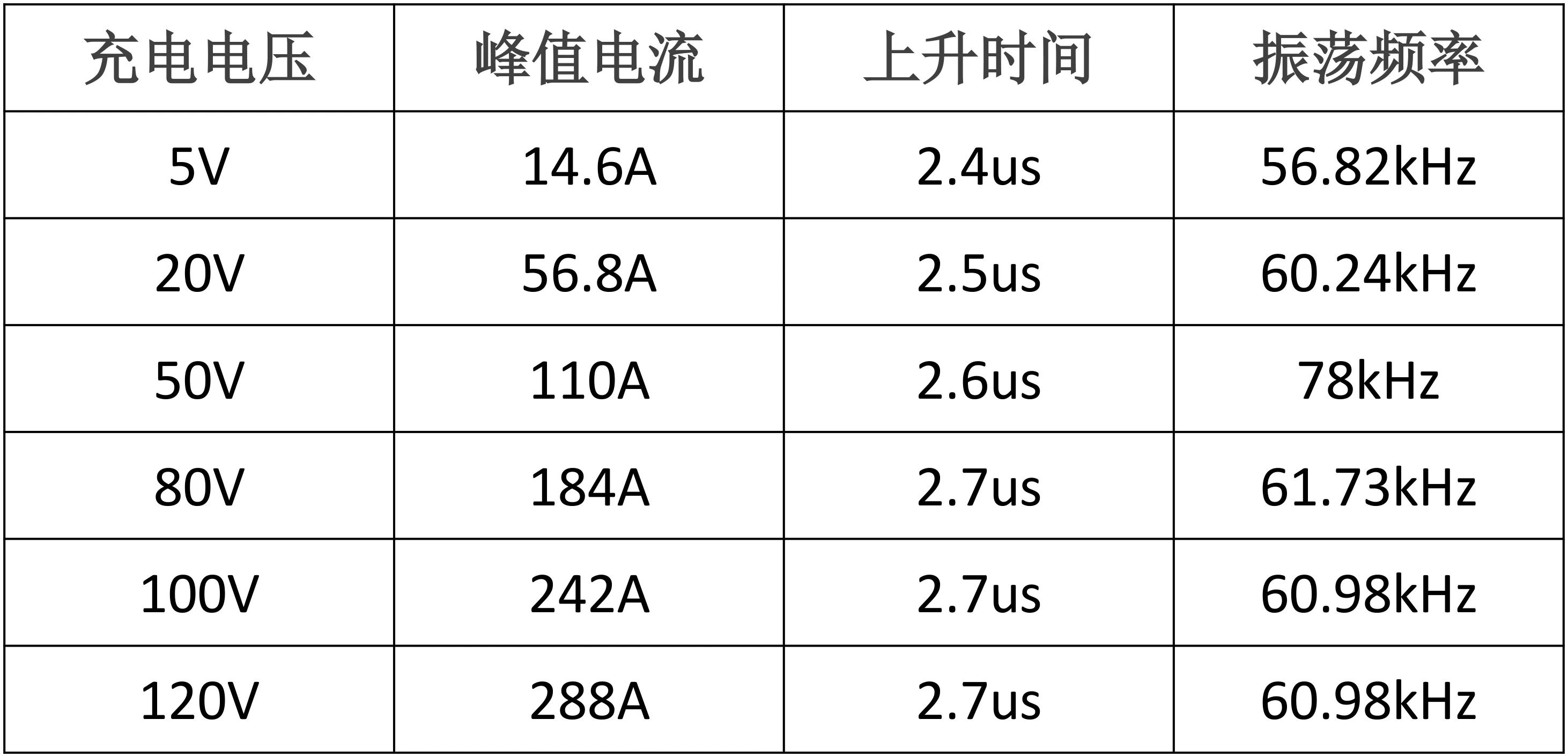
Experimental data
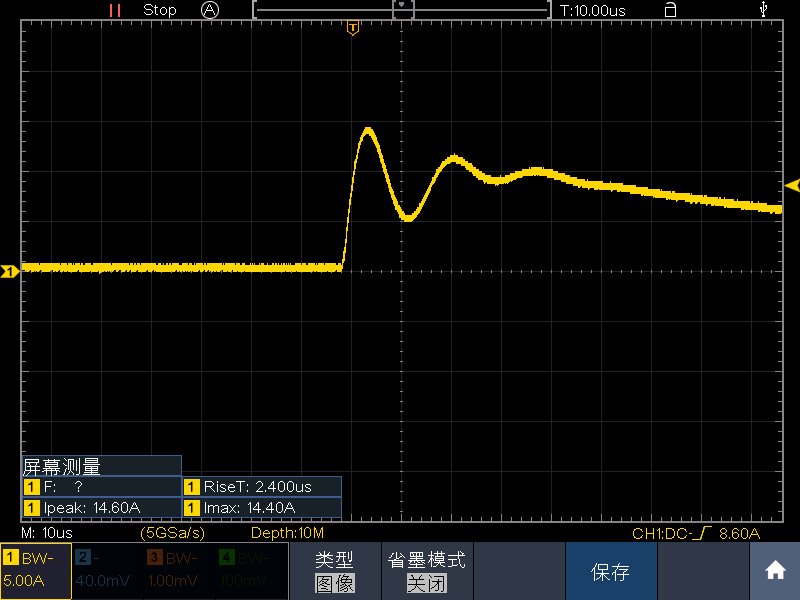
Classic Experimental Waveforms
Low-voltage test: 5V charging voltage
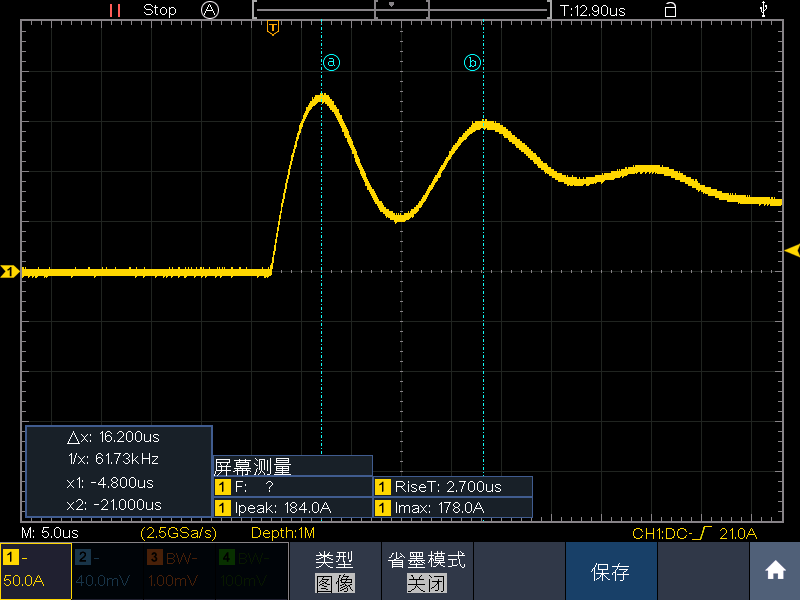
High-voltage test: 80V charging voltage
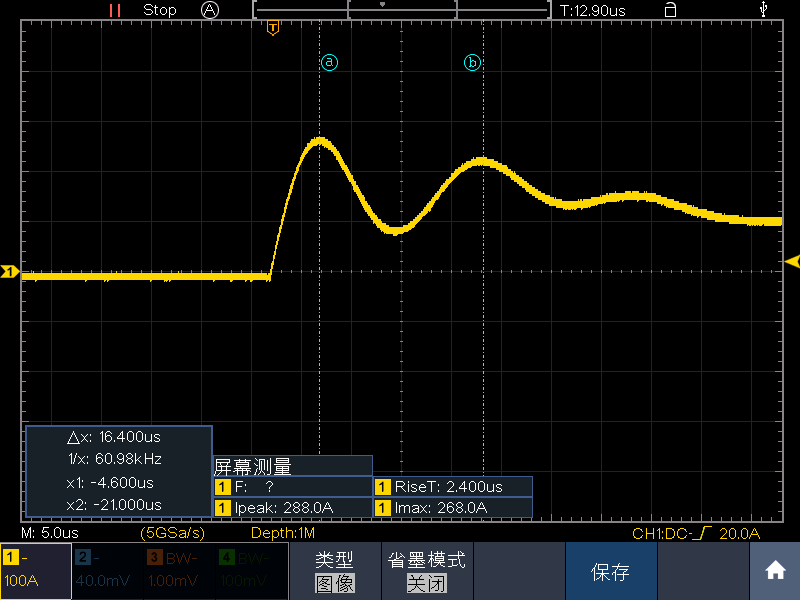
High-voltage test: 120V charging voltage
Analysis
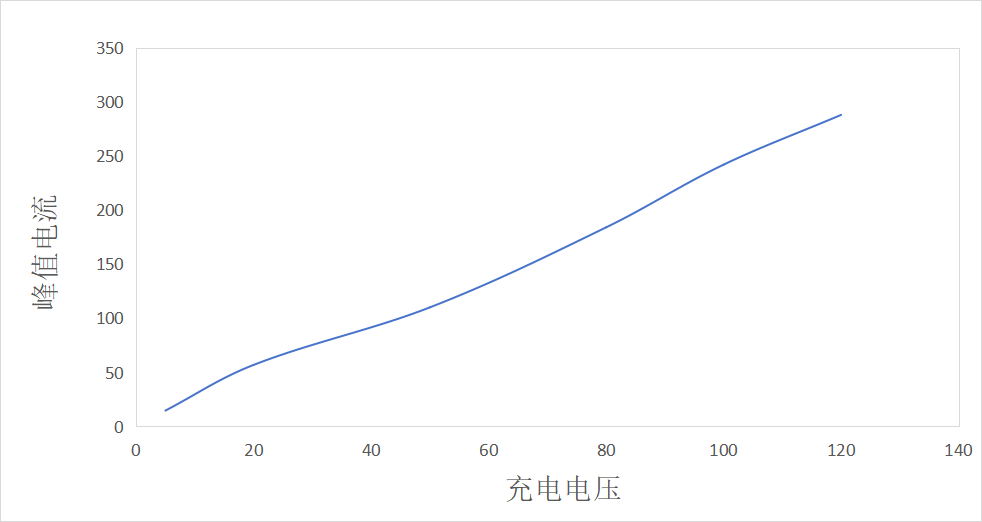
Based on the above data, the transient peak discharge current of the capacitor exhibits an approximately linear proportional relationship with the charging voltage, with a proportionality coefficient of approximately 2.4 A/V. However, deviations may occur at certain voltage points, potentially due to measurement errors or temporary variations in ESR. Furthermore, it can be reasonably determined that the oscillation frequency is unrelated to the charging voltage.
5. Significance of the Experiment and Application Extensions
This experiment comprehensively reveals the transient current characteristics of capacitor discharge through stepwise voltage application and precise measurement. Its applications include:
Energy storage system design: Optimizing parallel capacitor bank topologies to reduce loop parasitic inductance;
Power device selection: Matching IGBTs or MOSFETs based on measured current peaks and di/dt data;
Safety standard validation: Providing experimental data support for short-circuit protection circuit design in high-voltage equipment.
6. Summary
The PINTECH DK Series Flexible Current Probe delivers a high-precision solution for capacitive discharge transient current analysis, leveraging its high bandwidth, wide current range, and non-contact measurement capabilities.