
Power Amplifier Selection Guide: Understanding AC/DC Current Limiting from Heat Dissipation
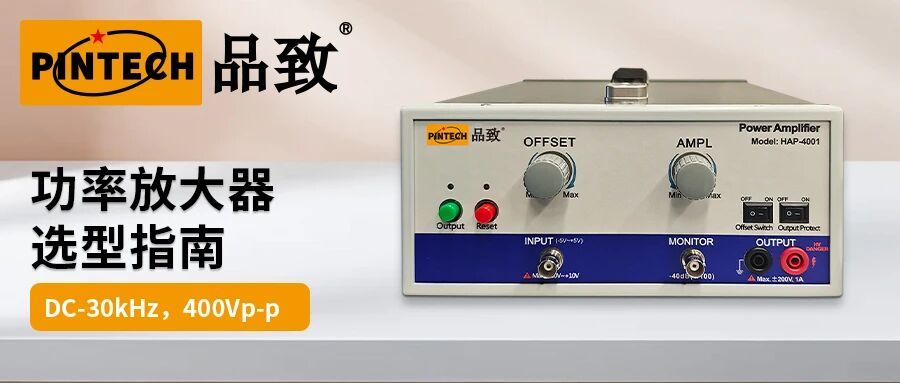
When selecting a power amplifier, reviewing specifications often reveals a seemingly contradictory phenomenon: for example, the Pinch HAP-4001 amplifier has a DC current rating of only 0.5 A, yet its AC current can reach 2.8 A (peak-to-peak). This discrepancy is not a design contradiction but reflects the amplifier's core limitation—heat dissipation capability is the true bottleneck, not merely the current output capacity.
In a typical Class A/Bpush-pull amplifier, the output stage typically consists of two power transistor pairs: the upper transistor pulls up the output voltage, while the lower transistor pulls down the output voltage. The difference in DC and AC output capability fundamentally stems from the heat distribution mechanism of the power transistors under different signal types and its impact on thermal resistance.
●DC Output: Continuous heating of a single tube, concentrated thermal stress
When outputting a DC signal, only one of the upper or lower transistors remains continuously conductive. The entire amplifier's dissipated power is borne solely by this transistor, causing continuous heat generation without interruption.
The junction temperature increase follows the formula: ΔT = P_diss × Rθ_total (where the total thermal resistance Rθ_total includes multiple stages such as junction-to-case, case-to-heatsink, and heatsink-to-air). Continuous heat generation causes the junction temperature to rise steadily. Therefore, the DC current and voltage must be limited within the safe thermal dissipation range of a single power transistor; otherwise, overheating will cause damage.
●AC Output: Dual-tube alternating conduction, thermal stress dispersion
When outputting an AC signal, the upper and lower transistors operate alternately with the signal cycle. Power dissipation is shared between the two transistors, with each conducting only during half a cycle and remaining in cutoff mode for the other half to dissipate heat.
Although instantaneous power may be high, the intermittent cycle of “heat generation–heat dissipation” prevents sustained accumulation of junction temperature, significantly mitigating the impact of thermal resistance on temperature. Consequently, even with total average power consumption equivalent to DC conditions, the amplifier can safely deliver higher peak currents.
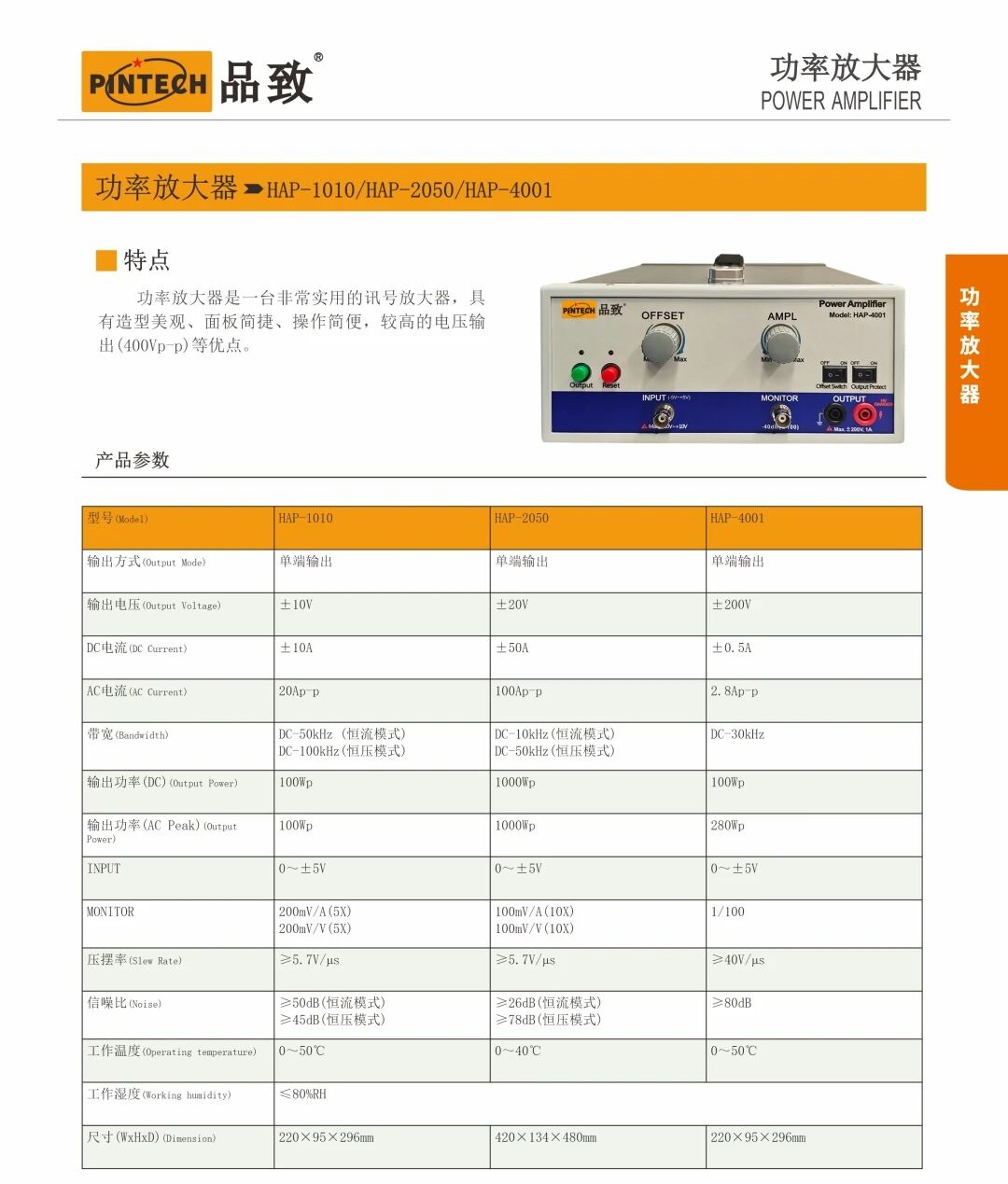
The output capability of an amplifier is fundamentally constrained by its thermal performance, specifically manifested in the trade-off between Power Dissipation (P_diss) and thermal resistance (Rθ):
●Power Dissipation is the portion of power converted into heat within a device, acting as a “heat source”.
●Thermal resistance represents the resistance to heat transfer from the junction to the surroundings, indicating “heat dissipation capability”.
●Both factors jointly determine the junction temperature (T_j) of the device, and the junction temperature directly affects the device's reliability and lifespan.
The temperature difference between the junction temperature and the environment temperature can be expressed by the following fundamental thermodynamic formula: ΔT = P_diss × Rθ_total.
●ΔT: Junction temperature minus environment temperature (ΔT = T_j - T_a).
●P_diss: Power Dissipation (unit: W).
●Rθ_total: Total thermal resistance (unit: °C/W)
Given the maximum junction temperature T_j_max, the total thermal resistance Rθ_total directly determines the maximum allowable power dissipation P_diss_max that the device can withstand. The lower the thermal resistance, the better the heat dissipation performance, and the higher the permissible power consumption.
From the perspective of thermal dissipation, an amplifier's output capability is constrained by its average power consumption rather than instantaneous current. DC signals cause sustained heating in individual transistors, necessitating strict current limitations. In contrast, AC signals exhibit fluctuating characteristics with lower average currents, permitting higher peak currents for brief durations.
Therefore, when selecting a power amplifier, in addition to considering AC and DC current values, greater emphasis should be placed on whether its output power, dissipation power, and thermal design meet the thermal environment requirements of the actual application. Only by ensuring that the junction temperature doesn't exceed the rated value under all operating conditions can the amplifier be guaranteed to operate reliably and sustainably.