How to simply measure the amplitude at the -3dB point to determine bandwidth

In electronic system testing and analysis, bandwidth is the core indicator for measuring the system's frequency response capability, and the amplitude -3dB point (half power point) is the industry's unified bandwidth calibration standard. This article will briefly explain how to determine the bandwidth of various systems by measuring the amplitude at the -3dB point.
1. Definition of Core Concepts
The amplitude -3dB point (also known as the half power point) refers to the frequency point at which the output amplitude (power amplifier) or acquisition amplitude (voltage probe) of the device drops to 0.707 times the maximum amplitude (corresponding to the power dropping to 1/2 of the maximum value).
The theoretical basis is derived from the definition of decibels (dB): the formula for calculating the attenuation amount corresponding to a 3dB amplitude attenuation is 20lg (A/A0)=-3dB, and it can be derived that A=A0 × 10 ^ (-3/20) ≈ 0.707A0 (A0 is the maximum output/acquisition amplitude of the device).
The bandwidth of power amplifiers and voltage probes is defined as the frequency corresponding to the -3dB point or the difference between two points on their amplitude frequency characteristic curve (bandpass). The measurement logic of the two is consistent, and only the measurement details need to be adjusted based on the equipment characteristics.
2. Simple measurement steps (applicable to power amplifiers and voltage probes)
The measurement core is to first determine the maximum amplitude of the device, then locate the frequency point corresponding to -3dB, and finally calculate the bandwidth. The steps are simple and practical:
Calibrate maximum amplitude: For power amplifiers, input a sine signal with a constant amplitude (usually the maximum output amplitude), measure and record its maximum output amplitude A0 through frequency scanning operation (the oscilloscope bandwidth should be much larger than twice the test bandwidth); for voltage probes, connect a standard signal source, and record its maximum acquisition amplitude A0 after frequency scanning.
Calculate the amplitude corresponding to -3dB: According to the theoretical relationship, calculate the amplitude corresponding to the -3dB point as A_ (-3dB)=A ? × 0.707.
Locate the -3dB frequency point (record the position with the cursor): Continue scanning the frequency and find the frequency point where the output/acquisition amplitude is equal to A (-3dB). At this point, the frequency is the -3dB cut-off frequency.
Calculate bandwidth: BW=cutoff frequency or=f_H - f_L (bandpass), to determine the bandwidth of the power amplifier or voltage probe.

3. Detailed rules for measuring sub equipment
The working principles of power amplifiers and voltage probes are different. When measuring, it is necessary to adjust the details specifically to ensure measurement accuracy. The specific points are as follows:
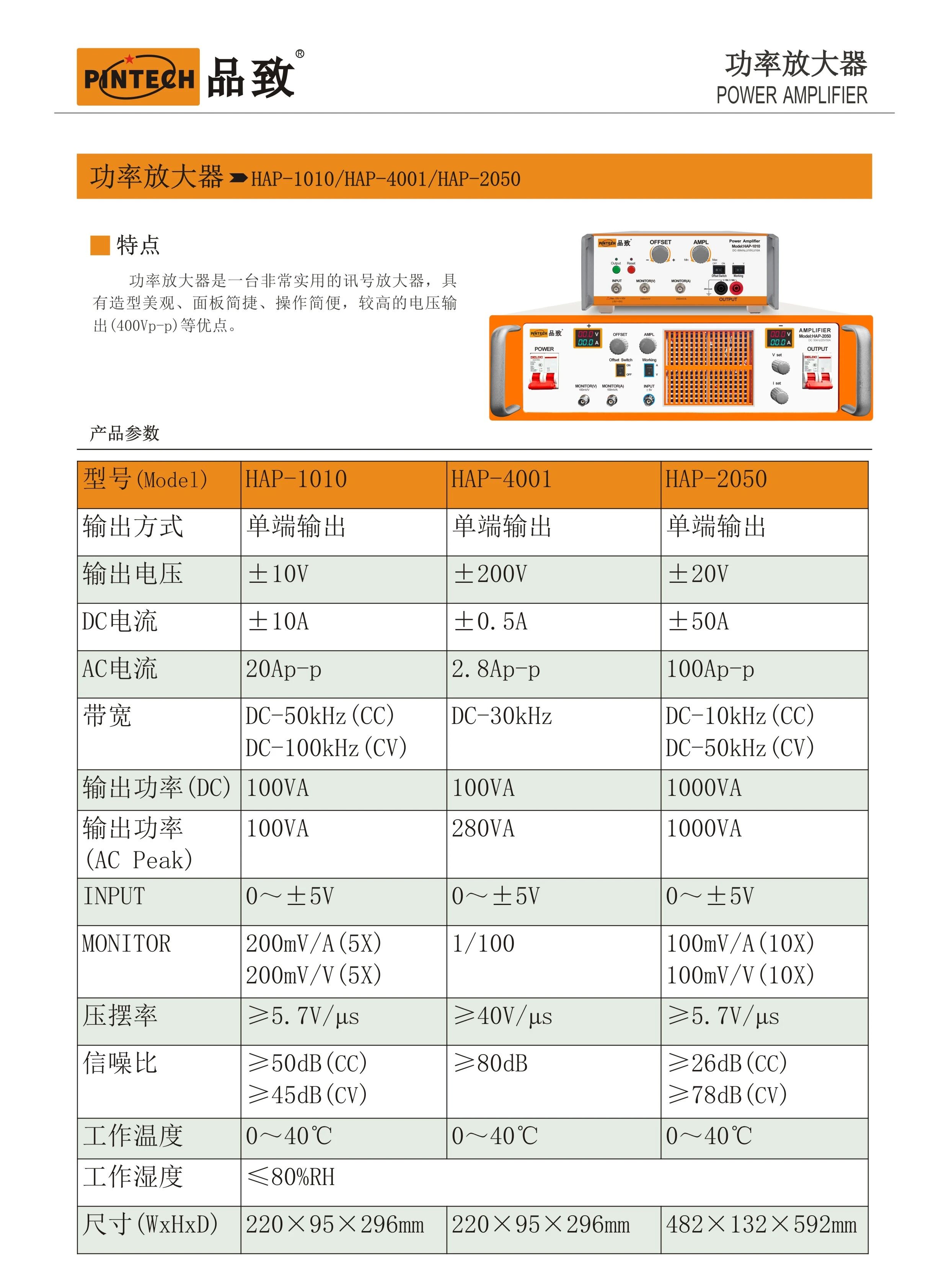
Power amplifier: The low-frequency output amplitude of the power amplifier is the highest, and the amplitude gradually decays as the frequency increases. Only the high-frequency end -3dB point f_c (cut-off frequency) exists. When measuring, it is necessary to ensure that the input signal amplitude is within the rated input range of the amplifier, avoid overload distortion, and find the high-frequency frequency f_c corresponding to the amplitude reduced to 0.707A0, which is its bandwidth, that is, BW=f_c.
Voltage probe: Voltage probes are divided into active probes and passive probes, both of which follow the calibration principle of "reducing the amplitude to 0.707A0 is the -3dB point". Passive probes have significant high-frequency attenuation, with only the -3dB point at the high-frequency end, and the bandwidth is the high-frequency cutoff frequency; The active probe has a wide bandwidth range, and some models have two -3dB points at low and high frequencies. The bandwidth is the difference between the two cutoff frequencies (f_H-f_L). When measuring, it is necessary to ensure that the probe matches the signal source and oscilloscope to avoid measurement errors caused by impedance mismatch.
4. Summary
The amplitude -3dB point is the core benchmark for defining the bandwidth of power amplifiers and voltage probes, both of which can be measured through the general process of "calibrating the maximum amplitude → calculating the -3dB amplitude → locating the -3dB frequency point → calculating the bandwidth". In practical operation, it is necessary to adjust the details based on the rated input and output range of the power amplifier, the type of voltage probe (active/passive), and impedance matching requirements. With the help of professional instruments, measurement efficiency and accuracy can be greatly improved.