
How to choose a suitable high-order low-pass filter
A high-order low-pass filter is a filter implemented by combining multiple second-order filter stages, used to suppress high-frequency signals and preserve low-frequency signals.
From the perspective of signal processing, all signals in the world can be understood as the superposition of one or multiple or infinitely many sine waves with different frequencies, phases, and amplitudes.
Definition of filter core: A device or algorithm capable of extracting or suppressing specific frequency components from complex signals.
A low-pass filter allows low-frequency signals to pass through, while rapidly attenuating or blocking signals outside the allowable frequency range. Its main purpose is to filter out electromagnetic interference in sensor signals and noise in audio signals.
The implementation methods of filters are divided into passive filtering and active filtering. The primary difference between the two lies in whether an additional power supply is required. Passive filtering primarily consists of passive components (R, C, L), utilizing the impedance characteristics of capacitors to pass high frequencies and block low frequencies, and inductors to pass low frequencies and block high frequencies to filter frequencies. Its circuit is simple and easy to implement, making it widely used in power supply filtering and high-frequency filtering. Active filtering mainly consists of active components (primarily operational amplifiers) and passive components (primarily R and C). Operational amplifiers alter the frequency response of the circuit through a feedback network, enabling both filtering and compensation for signal attenuation (or amplification of the signal). The filtering characteristics (cutoff frequency, attenuation slope) are easier to control precisely.
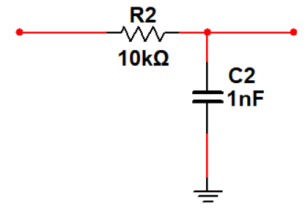
passive filtering
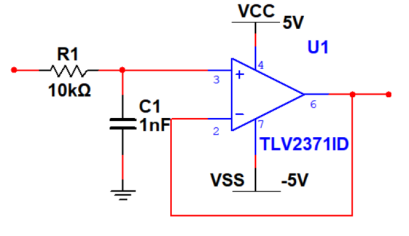
active filtering
However, passive filters, due to their filtering characteristics and poor load characteristics, have an attenuating effect on signals during the filtering process. Adding buffer operational amplifiers to a high-order filter chain can also reduce the attenuation between each link in the chain and prevent the filter components in the chain from distorting the filtering characteristics of other filter components in the chain. As can be seen from the figure below, with the same filtering parameters and the same load, passive filtering has a more severe attenuation effect on signals.
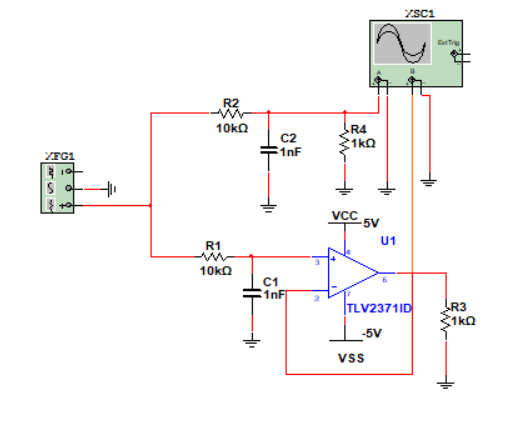
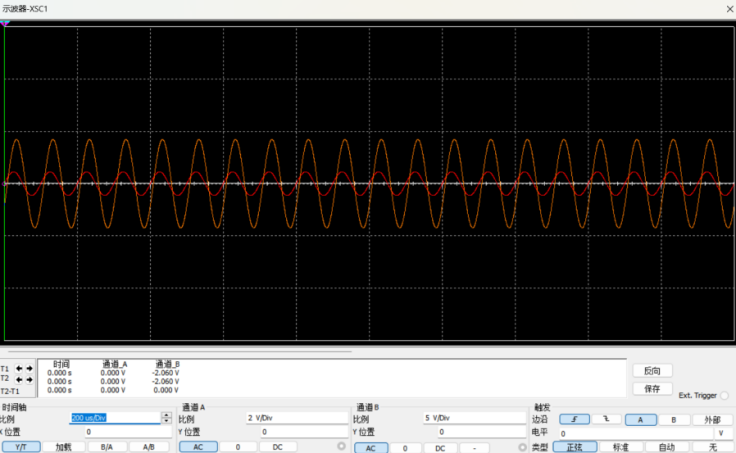
The degree of signal attenuation caused by active filtering (orange) and passive filtering (red)
Therefore, active filtering is usually adopted for high-order filtering.
Compared to second-order filtering, higher-order filtering exhibits stronger roll-off capability. When selecting the order, the order of the filter refers to the number of poles in the filter's transfer function, which determines the rate of decline in the transition region. Generally, each additional order (one pole) corresponds to an increase of 20dBDec (20dB per decade).
The Sallen-Key architecture is commonly used for implementing high-order filter architectures.
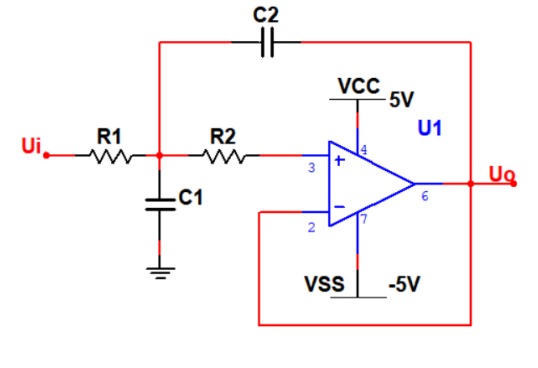
circuit
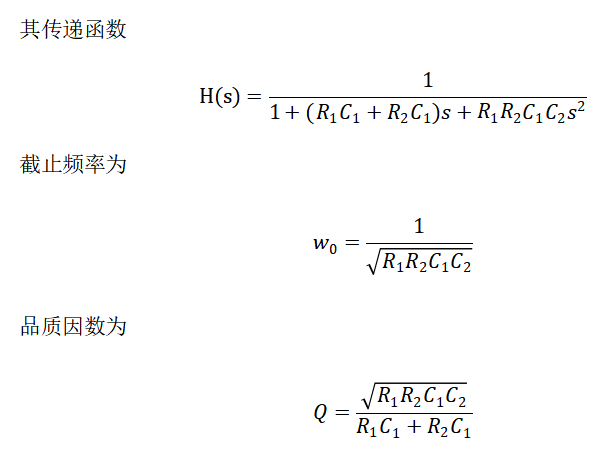
Common high-order low-pass filters include Butterworth, Bessel, and Chebyshev filters
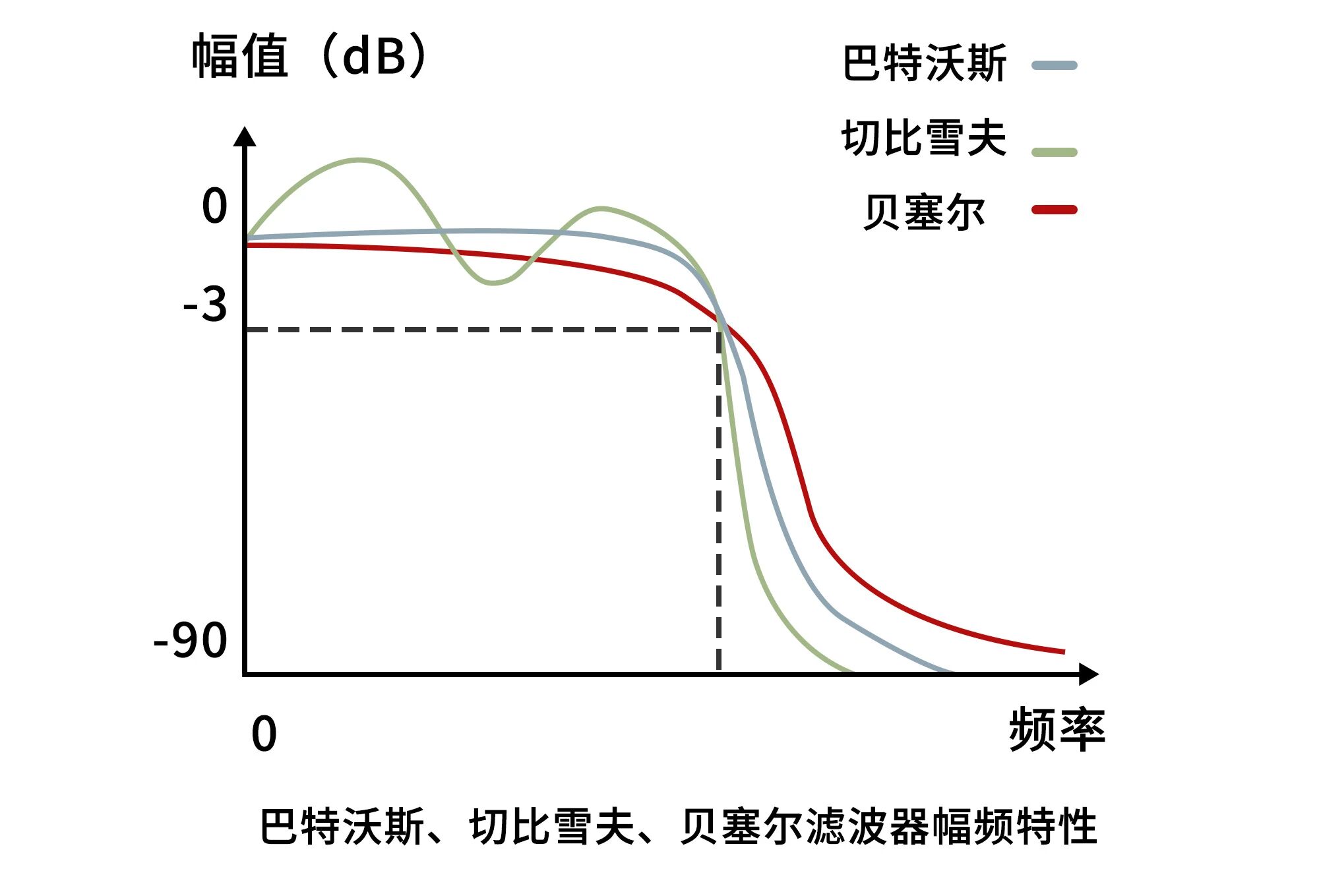
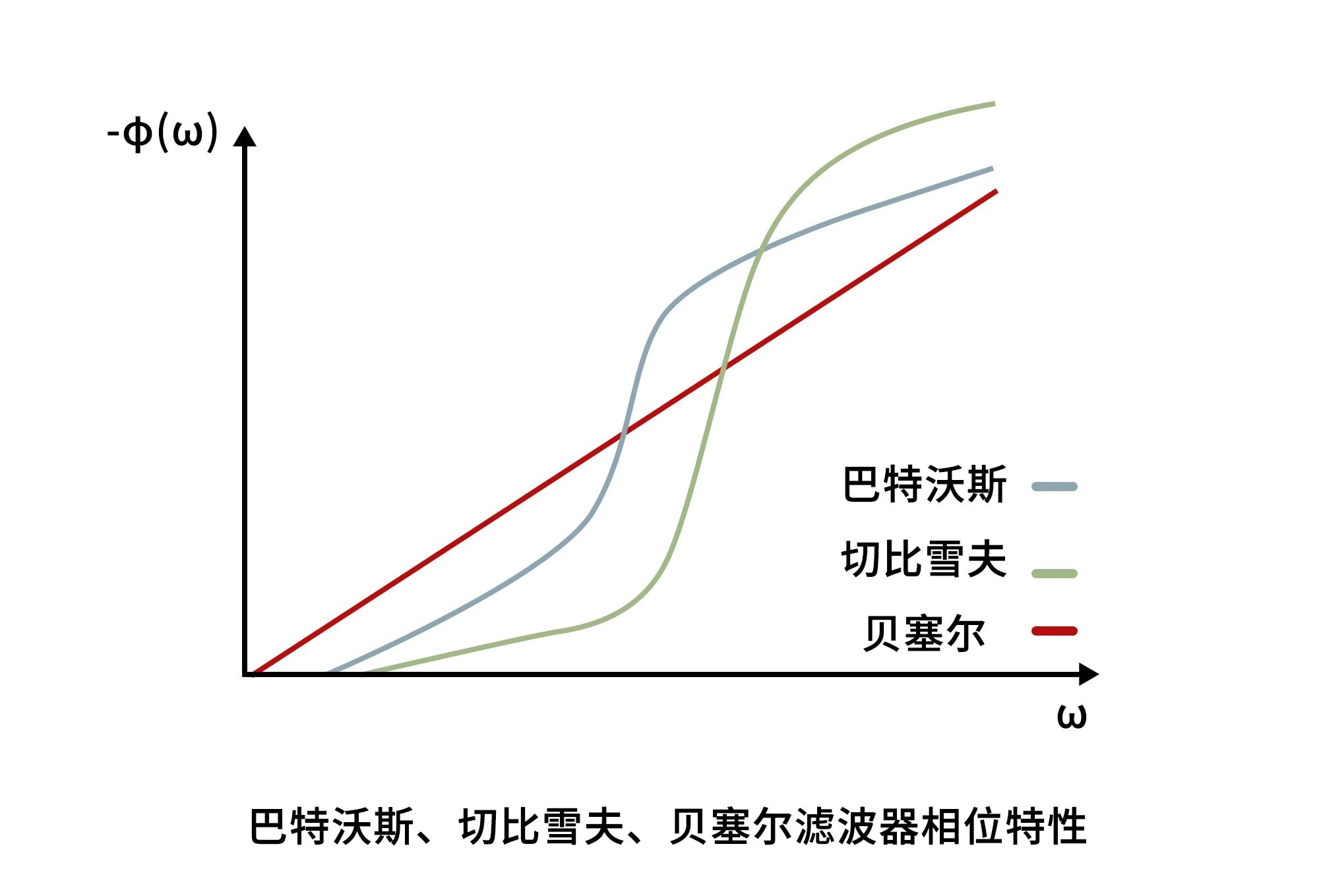
The Butterworth filter has the best flat response, characterized by a frequency response curve that is maximally flat within the passband, with no fluctuations, while gradually decreasing to zero in the stopband.
The Bessel filter exhibits the flattest amplitude and phase response, possessing the characteristic of providing equal delay to all frequencies below its cutoff frequency.
The Chebyshev filter features rapid attenuation, achieved by allowing fluctuations in the frequency response.
They each have their own advantages and trade-offs in different application scenarios, and should be selected based on specific needs.