
What is power dissipation?
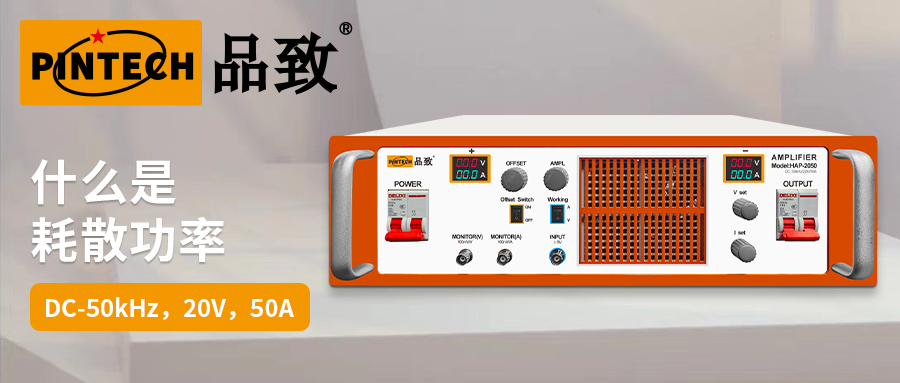
“Power dissipation” refers to the power consumed (or “lost”) by an electrical or electronic component during operation as it converts electrical energy into heat.
For power amplifiers, specifically referring to the heat dissipation of linear devices, when the amplifier operates in the first quadrant, the dissipated power equals (supply voltage - output voltage) × output current.
Power dissipation causes heat generation and temperature rise. When exceeding rated values, it may shorten lifespan or cause damage. Therefore, when using power amplifiers, it is essential to monitor power dissipation under current operating conditions and ensure it remains within safe limits.
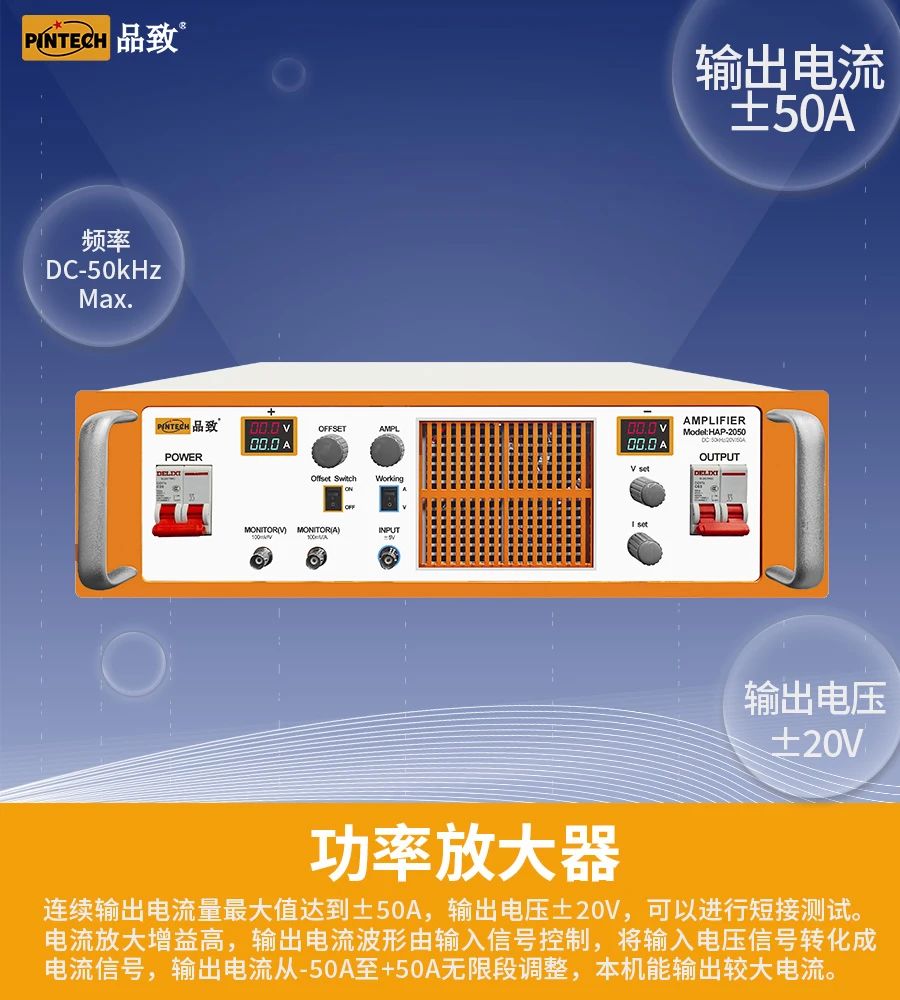
Power Amplifier HAP-2050, maximum output ±20V/±50A, supports operation in constant current or constant voltage mode, with adjustable voltage and current for the internal output stage power supply.
The following examples illustrate first-quadrant DC operating conditions:
Output Stage Power Supply Settings (Voltage/Current) | Output (voltage/current) | Output Power | Power dissipation |
24V/50A | +20V/+50A | 1000A | 200W |
24V/50A | +10V/+20A | 200W | 280W |
24V/50A | +5V/+50A | 250W | 950W |
10V/50A | +5V/+50A | 250W | 250W |
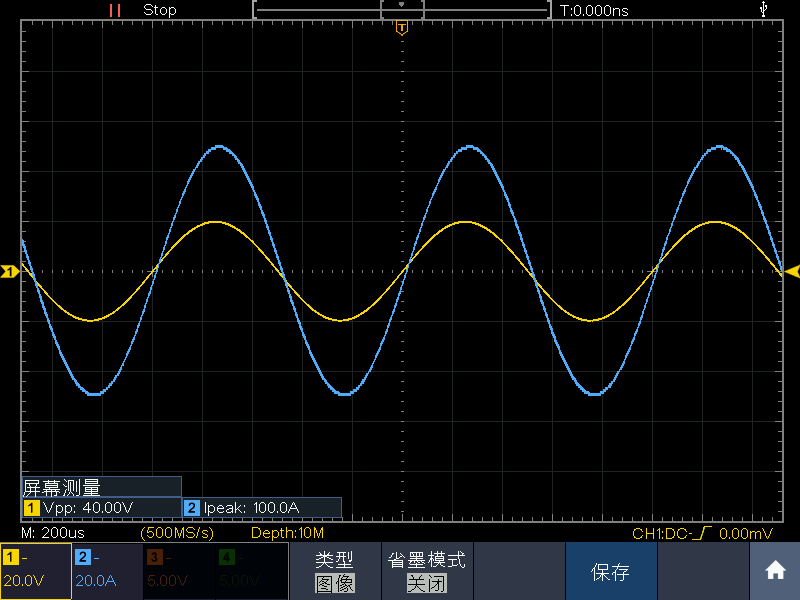
Using the MDO704 oscilloscope to test the output waveform of the power amplifier 2050 delivering 20V 50A.
As shown in the table above, when outputting +5V/+50A, adjusting the output stage power supply voltage from 24V to 10V reduces the power dissipation from 950W to 250W—a decrease of 700W. Proper configuration can minimize power dissipation while maintaining constant output voltage and current.
Power Amplifier HAP-2050 Rated Dissipation Power: DC 500W / AC 1000W. Internal over-temperature protection is built-in. When the device temperature rises to 60°C, the cooling fan will operate at full speed. When the device temperature rises to 90°C, the output stage power supply will shut down the output.
SummaryThe HAP-2050 power amplifier allows estimation of dissipated power prior to use, enabling calculation of output voltage and current to estimate the device's dissipated power. Correctly set the output stage power supply voltage and current to ensure operation within the device's rated safety limits.